


We all like being right. It’s one of the more persistent and forgivable features of being human. No one plays Jeopardy! hoping to lose. There’s an immediate dopamine hit of self-worth and comfort from a world that rubber-stamps something we knew we knew already. Our brains are remarkably efficient at manufacturing that feeling, generating cognitive shortcuts and implicit biases that sand down the rough edges of a complicated reality into something smooth and agreeable. In psychology, confirmation bias is perhaps the most well-worn of these shortcuts: we seek evidence that supports what we already think, discount evidence that doesn't, and move through the world in a kind of self-reinforcing loop.
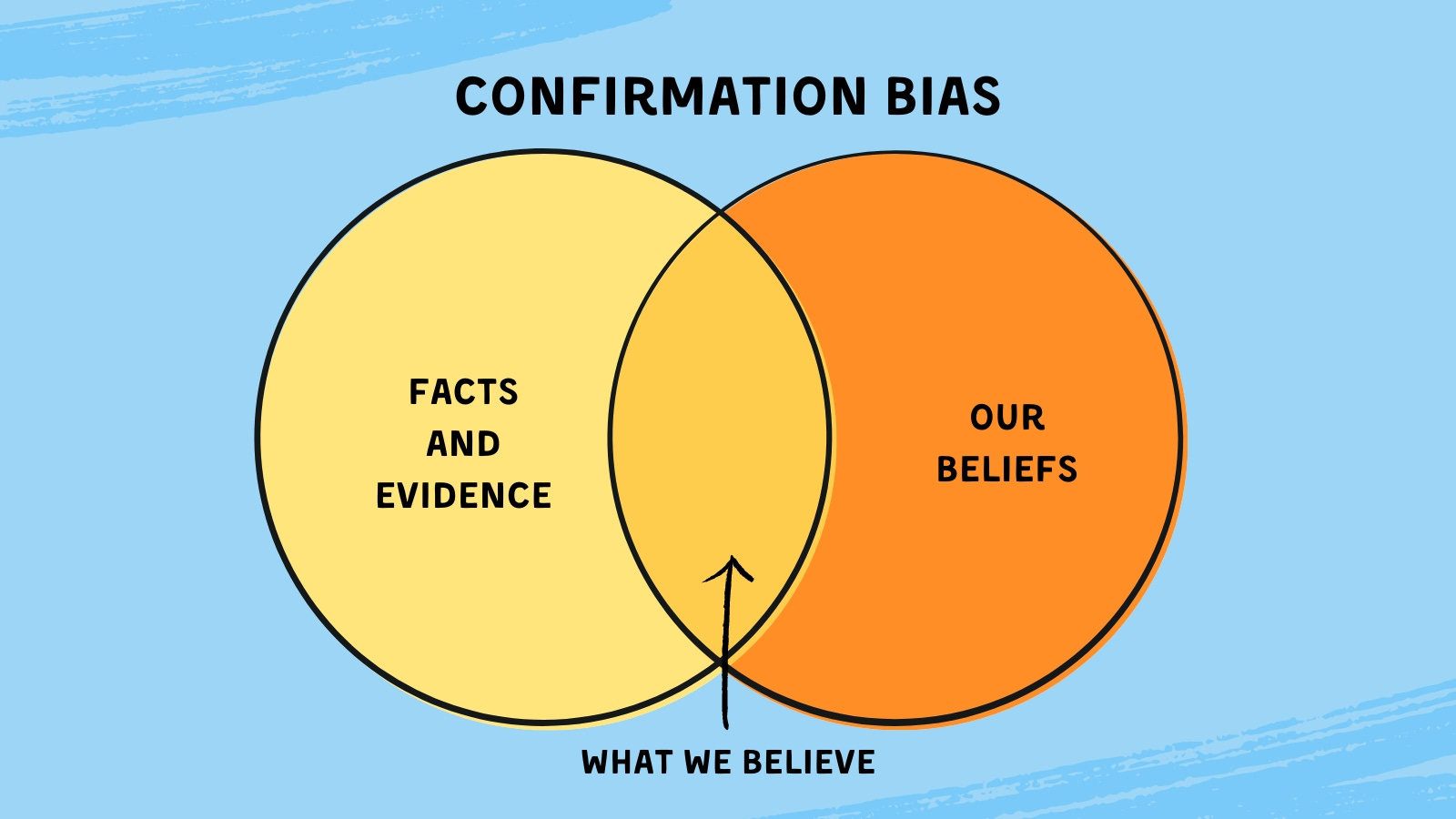
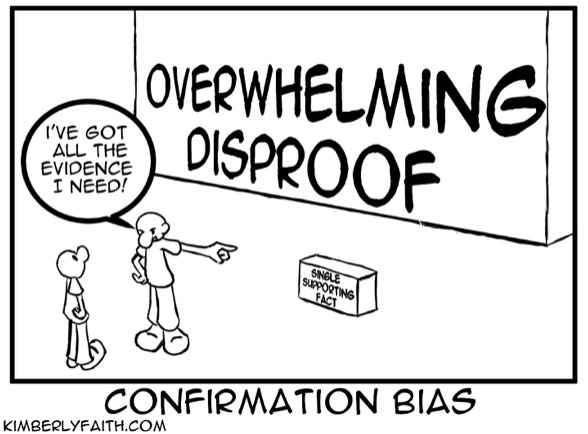
With generative AI becoming daily-use tools, everyone has experienced this on one level or another. Chatbots are polite, encouraging, and complimentary to our prompts. To varying degrees of obviousness, they are inclined towards agreeing with a prompt and further codifying whatever is expressed in it’s content. Excellent recent research has called attention to these potential issues and begun to map their root causes on both the technology side and the human user side with some precision. Yiran Du, publishing from the Institute of Cognitive Neuroscience, examined the structural risk of confirmation bias embedded in the design and inference functions of leading AI chatbots. Grace Chang and Heidi Grant wrote in the Harvard Business Review about the ways our preexisting human beliefs interact with generative AI to amplify those biases back at us, louder and more convincingly than before. Taken together, the concern is that the most powerful reasoning tools in human history may be quietly, efficiently, making us more certain and less curious.
Being right is an outcome. A satisfying one, no doubt. Yet, as a sustained state of mind, it has rapidly diminishing returns. Established industries and legacy corporations, the antitheses of startup entrepreneurship, are often positioned as such due to ingrained inability to adapt and innovate which are reinforced, if not also originating, from various flavors of confirmation bias. Many plateau or are eventually undone by rooms of smart people who abandon critical thinking and inquisition for perpetual reinforcement of consensus or leadership belief. This business dynamic produces executive yes men and women and only good news conference rooms. The relentless certainty of confirmation biases playing out across industries and decades are the case studies behind Clayton Christensen’s Innovator’s Dilemma.
What’s lost in the pursuit of being right is something harder to name and harder to sustain: the productive discomfort of not yet knowing. Of holding and wrestling with opposing forces or ideas and deliberately refusing to resolve the tension prematurely.
Like confirmation bias, this condition has a clinical name. Leon Festinger defined cognitive dissonance in the 1950s as the mental discomfort experienced when holding conflicting beliefs, values, or ideas at the same time. Much of the literature treats it as a problem to be solved. Most people, most of the time, do solve it by retreating to whichever belief feels safest. Confirmation bias is, in fact, one of the brain's most reliable antidotes to the discomfort of cognitive dissonance.
I’m going to push back on the premise that the discomfort is the problem. Cognitive dissonance, held rather than resolved, is not malfunction. It is often, I would argue, an essential precondition towards many things new and profound, innovative and artistic.
Many of the 20th century’s literary geniuses knew this well.
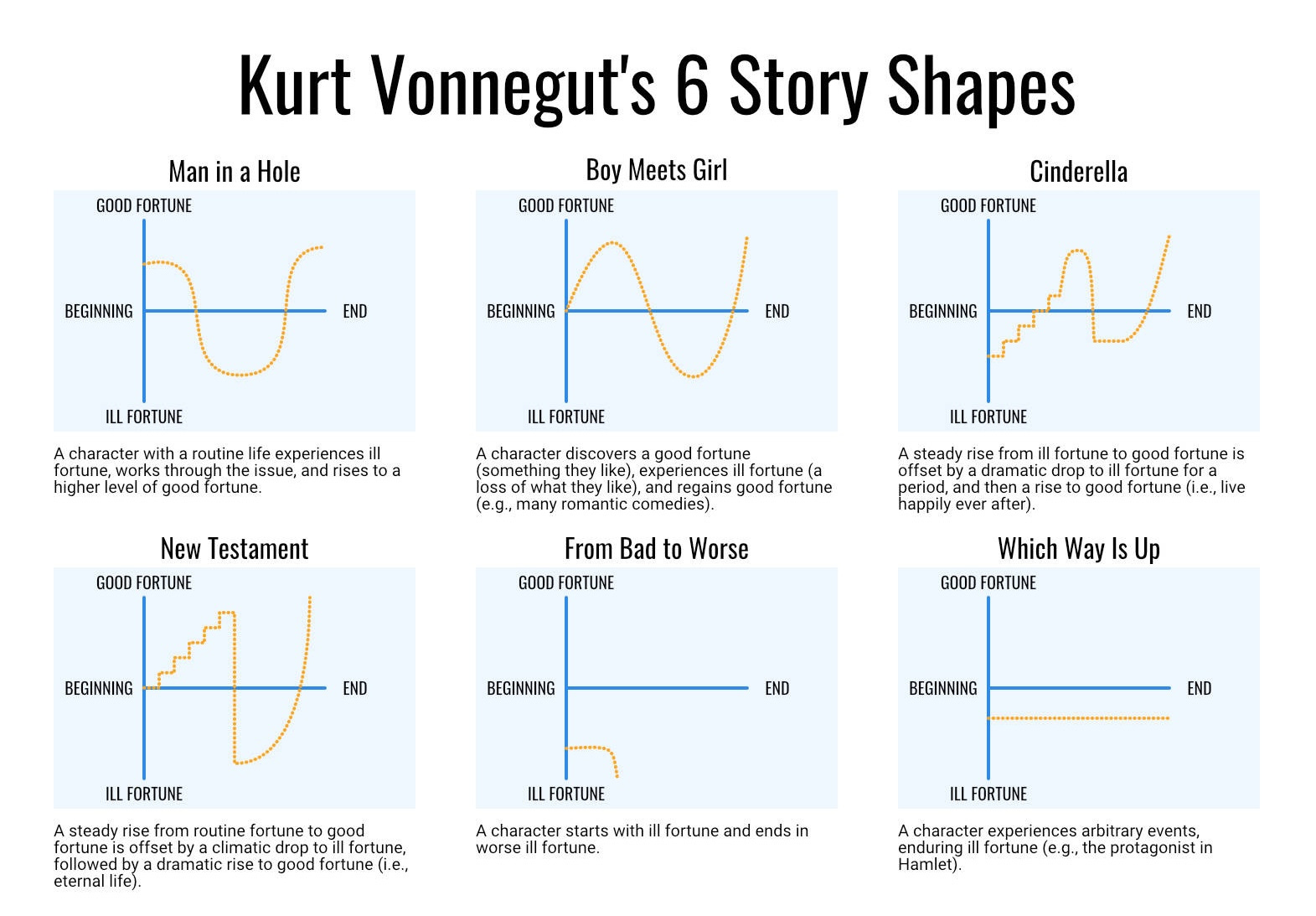
Take Kurt Vonnegut’s famous lecture diagraming the 6 shapes of stories. Across cultures and traditions, he found, narrative requires movement through difficulty. Not one of his story shapes rests in the comfort of confirmation. Every arc passes through friction, be it loss, reversal, conflict, disorientation, and it is precisely that friction that gives stories their meaning and weight.
William Faulkner, accepting the Nobel Prize for Literature in 1950, was even more direct. The only thing worth writing about, he said, is the human heart in conflict with itself. conflict within, an interior tug, and irresolvable tension between competing felt truths are the definitive ingredients for genuine character depth and the whole territory of literature.
J.R.R. Tolkien, building Middle-earth from first principles, began his creation mythology with music. In his Ainulindalë, the universe itself is sung into existence by angelic voices. When asked why evil exists in his world, the answer was thus musical. For Tolkien, in order to make the most beautiful, astonishing, complex music possible, one must have the minor notes (his musical manifestation of evil). Discord isn't the enemy of harmony. It's the thing that makes harmony matter.
Fiction resonates as a cypher and hall of mirrors. Stories and characters stay with us because we recognize ourselves and our lived experiences in them. Life imitates art.
While literature has long valued creativity through adversity, life alongside artificial intelligence may be best pursued through imitating this core aspect of the art form. Many of the same cognitive tensions that make novels endure are the ones that can make founders and technology startups capable of genuine breakthrough.
We are often at our most creative and innovative when we ruminate:
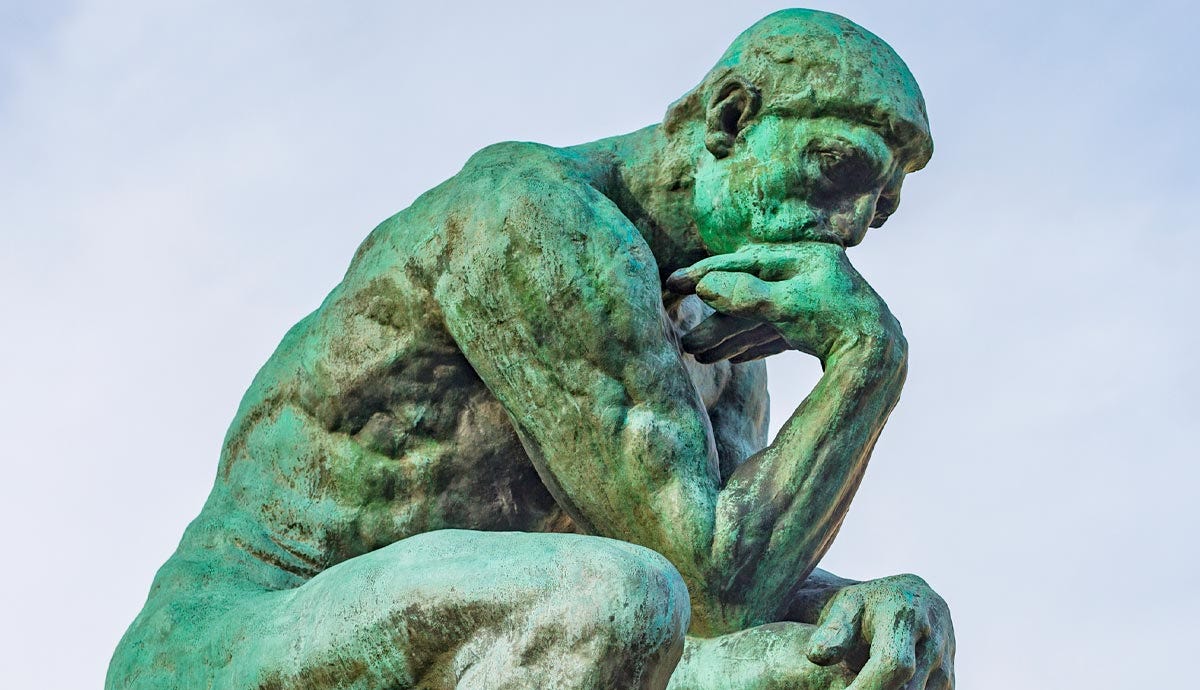
Problem-solving, by definition, is an exercise in wrestling with a version of cognitive dissonance. And it is thinking clearly, deeply, and precisely about a problem, in doing so, manifesting a vision for building something new, something better, that fixes that problem, which tends to define the most successful entrepreneurship. When a founder sits with a business idea that looks wrong from every conventional angle they are living inside productive cognitive dissonance. This is what Chris Dixon once called in a talk: “Good Ideas That Look Like Bad Ideas”. The tension is an environment in which something original becomes possible. The prerequisite being a willingness to hold conflict without immediately collapsing it.
The entrepreneur’s adversary, legacy corporate industry discussed earlier, has long been diagnosed as readily susceptible to detrimental confirmation bias. The Innovator’s Dilemma was published nearly 30 years ago. A much more recent set of competing priorities has emerged in entrepreneurship and the modern organization as they both embrace and encourage AI today in their workflows, processes, and across their teams. One of AI’s primary value propositions is saving time. And if an accepted expectation is that AI enables faster output generation, be that a startup team rapidly scaling their product or a corporate department mandating 3x project completion times, users will naturally feel pressure to work faster. Such acceleration often occurs at the expense of critical evaluation.
The willingness to sit with opposing ideas is what separates exploratory thinking from circular thinking. It’s the difference between using a powerful tool to go further and using it to stay exactly where you are, only more comfortably. With generative AI, these creative tensions can be engaged and explored as easily as confirmation bias can be amplified. The AI chatbot, by the technology’s architectural design, produces the most plausible textual continuation of a given text prompt. Feed it your assumptions, and it will extend them with remarkable fluency and confidence. This is extraordinary when you want to accelerate and articulate what you already know. But it becomes a closed loop when what you actually need is to be challenged, reoriented, or shown the shape of what you haven’t considered yet.
However with these remarkably powerful AI technologies, the inverse is equally available to us and it’s every bit as potent and powerful. The same tools that can lock you into your existing frame of reference can, with different intent and different prompting, pull you out of it. You can ask a generative AI to argue the opposite position. To steelman the idea you find least convincing. To map the assumptions buried inside your own question. To break a problem, system, or issue down to it’s first principles or explain it in its complex entirety, including all competing concerns.
In generative AI, we now have the most powerful innovations in the history of technology to accompany and aid us in the intentional embrace of cognitive dissonance, especially in the worlds of startup and entrepreneurship. If we formulate problems and wrestle with them, AI can help us do so more thoroughly and meaningfully then we may ever have been able to on our own. The technology doesn’t determine the outcome. The posture of the person using it does.
—
Side Note: This month (March, 2026) marks 15 years since my very first blogpost on Tumblr about job search. For everyone still reading my stuff now and anyone who has along the way, thank you so much. It means the world to me.